
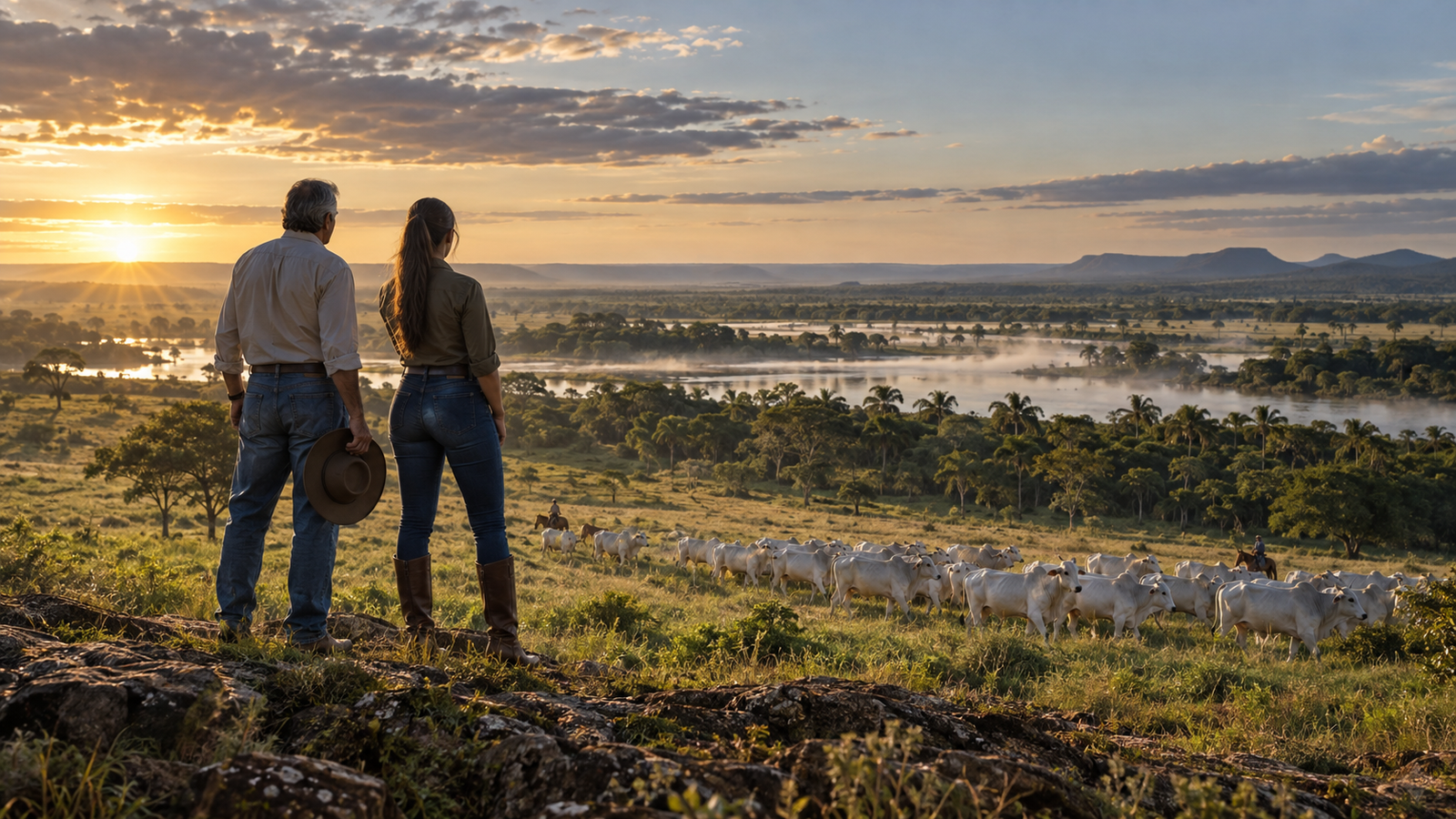
Why Brazilian cattle ranching needs its own Yellowstone
By the Editorial Team
Brazilian cattle ranching has impressive numbers. It is present across almost the entire country, supports an extensive economic value chain, contributes to food security and is woven into the history of millions of families. Yet despite its economic, social and territorial importance, it still struggles to tell its own story.
That is why Brazilian cattle ranching needs its own Yellowstone.
The American series turned conflicts over land, family succession, tradition, power, identity and a changing rural world into a story that captivated millions of people who had never set foot on a ranch. It did so not through institutional campaigns or speeches about the sector, but through characters, families, emotional bonds, contradictions and conflicts.
Brazil has more than enough material for something similar. We have the Pantanal, Cerrado, Amazon, Caatinga and Atlantic Forest. We have small, medium-sized and large farms. We have families who have worked in cattle ranching for generations, and young people deciding whether to stay in the countryside. We have women taking over farms, producers adopting technology and properties undergoing profound environmental and production changes.
And we have a particularly important story to tell: how cattle ranching can be part of the solution to some of this century’s greatest challenges.
In some Brazilian regions, producers are restoring degraded pastures, protecting springs and forests, conserving biodiversity, increasing productivity without necessarily expanding their land area, and seeking ways to reduce emissions from their operations. There is still a long way to go, but there is also a real opportunity to show that production and conservation do not have to stand on opposite sides of the same story.
There is another dimension often overlooked in discussions about rural life: producing food is a social responsibility. In a world that will need to feed billions of people in the coming decades, discussing the future of cattle ranching also means discussing food security, access to protein, production efficiency and our ability to produce food while conserving the natural resources on which that production depends.
These two priorities—environmental conservation and food security—can find extraordinary scope for innovation and transformation in Brazilian cattle ranching. Perhaps some of the most compelling stories lie precisely in the tensions within this process: between production and conservation, tradition and innovation, economic development and environmental responsibility, the knowledge of those who have spent decades in the sector and the vision of a new generation beginning to take over the farms.
These are Brazilian stories that urban Brazil still knows little about.
For a long time, much of the sector’s communication has focused on defending cattle ranching or presenting its numbers. That is important, but not enough. People rarely form emotional connections with economic sectors. They connect with people and stories.
Having our own Yellowstone, then, does not mean creating propaganda for cattle ranching. Quite the opposite. A meaningful story must show its complexity: its successes and mistakes, its transformations, generational conflicts, regional differences, environmental tensions and, above all, the people who live with these issues every day.
Perhaps this is one of the great opportunities for Brazilian cattle ranching in the years ahead: to become a protagonist in its own story, rather than simply the subject of other people’s narratives.
Because having a place in public debate means more than sitting at the table where decisions are made. It also means being present in the imagination of a society that is increasingly urban and distant from rural realities.
Brazilian cattle ranching needs to talk less about itself—and start telling more stories about who it is, the food it produces, the territories it helps conserve and the future it is willing to build.